










What Makes a Building “Mission-Critical”?
A mission-critical building is one in which an interruption can create significant consequences. Hospitals support life-sustaining functions. Command and dispatch centers must remain operational during emergencies. Data centers maintain digital infrastructure that powers essential business and finance operations. A mission-critical building supports essential operations, and these facilities require structural systems that accommodate:
- Concentrated equipment loads and elevated floor-loading requirements
- Large mechanical, electrical, and cooling systems
- Long, flexible floor plates that support changing equipment layouts
- Strict serviceability and vibration criteria
- Enhanced seismic resilience in applicable regions
- Accelerated construction and commissioning schedules
These requirements affect more than structural analysis. The grades and structural shapes selected by the engineering team establishes the procurement baseline for the project. Specifying an uncommon section, non-standard material grade, or difficult-to-source component can introduce schedule risk before fabrication begins.
Early coordination among structural engineers, fabricators, and steel suppliers can help align design intent with material availability.
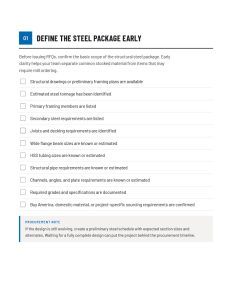 |
Download our Steel Procurement Checklist for MISSION-CRITICAL BUILDINGS |
Let’s talk about the structural steel specifications commonly used in mission-critical building frames and explain how material decisions can affect both performance and procurement.
Core Steel Grades for Mission-Critical Frames
Most structural steel specifications for mission-critical buildings rely on a relatively focused group of ASTM material standards. Clearly matching each grade to its intended application can reduce RFIs, simplify material verification, and help prevent substitutions that do not meet project requirements.
| ASTM Specification | Typical Application | Minimum Yield Strength | Key Characteristics |
| ASTM A992 | Wide flange beams and columns in primary building frames | 50 ksi | Commonly specified for rolled structural shapes; controlled mechanical properties and strong weldability |
| ASTM A500 Grade B or C | Square, rectangular, and round HSS used for bracing, platforms, and secondary framing | Varies by grade and shape | Standard specification for cold-formed welded and seamless carbon-steel structural tubing |
| ASTM A572 Grade 50 | Base plates, connection plates, stiffeners, and other structural components | 50 ksi | High-strength, low-alloy structural steel frequently used where greater yield strength is required |
| ASTM A36 | Miscellaneous steel and ancillary framing | 36 ksi | Common carbon structural steel used where strength requirements are comparatively modest |
| ASTM A53 Grade B | Structural pipe columns and round support framing | Varies by manufacturing method | Covers seamless and welded steel pipe used in structural and other applications |
ASTM A992 is widely used for rolled structural shapes in building construction. The specification covers structural shapes used in building framing, bridges, and general structural applications.
For mission-critical projects, engineers should also evaluate the availability of heavier wide flange sections before finalizing the framing schedule. Large or uncommon components may require mill sourcing rather than service-center inventory. Early distributor coordination is recommended because section availability can directly affect procurement strategy and project lead time.
Matching Structural Shapes to Mission-Critical Applications
Material grade is only one component of a complete structural specification. Shape selection affects load capacity, stiffness, connection design, fabrication, erection, and the ability to integrate building systems.
| Structural Shape | Common Mission-Critical Applications | Typical Material Specification |
| Wide flange shapes | Primary beams, girders, columns, gravity systems, and moment frames | ASTM A992 |
| Square and rectangular HSS | Braced frames, equipment platforms, mezzanines, secondary framing, and equipment-support structures | ASTM A500 Grade B or C |
| Round HSS | Lateral bracing, exposed columns, and applications requiring efficient properties about multiple axes | ASTM A500 |
| Structural channels | Cable-tray framing, equipment supports, secondary framing, and miscellaneous connections | ASTM A36 or ASTM A572, as specified |
| Structural pipe | Round columns, utility-support structures, handrails, and miscellaneous framing | ASTM A53 Grade B |
Wide flange beams are commonly used for long-span framing where open floor layouts support future equipment changes. In data centers, fewer interior columns can improve flexibility for server racks, electrical infrastructure, cooling systems, and equipment replacement.
HSS tubes are frequently used in lateral systems and equipment-support structures because square and rectangular sections provide useful compression and torsional properties. For modular or prefabricated construction, consistent section and grade specifications can also simplify repetitive fabrication.
Exact component sizes should always be determined through project-specific structural analysis. Early material availability reviews can identify sections that may be difficult to source before they become an obstacle to hitting your schedule milestones.
Governing Standards and Special Requirements
Mission-critical structural steel specifications typically reference several interrelated design, fabrication, and inspection standards.
ANSI/AISC 360
ANSI/AISC 360, Specification for Structural Steel Buildings, establishes generally applicable requirements for the design and construction of structural steel buildings and other structures. The standard incorporates both Load and Resistance Factor Design and Allowable Strength Design methods.
Structural engineers use AISC 360 as the primary framework for member design, stability, connections, and other structural requirements.
ANSI/AISC 341
Projects with seismic force-resisting systems may also be governed by ANSI/AISC 341, Seismic Provisions for Structural Steel Buildings. The provisions address the design, fabrication, and erection of structural steel and composite seismic force-resisting systems and are used with AISC 360.
Seismic applications may introduce additional requirements for member properties, connection detailing, welding, quality assurance, and material traceability.
AWS D1.1
Structural steel welding is commonly governed by AWS D1.1/D1.1M, Structural Welding Code – Steel. The current AWS standard addresses structural welding requirements involving design, fabrication, qualification, and inspection.
Project specifications may include additional requirements for critical load paths, weld procedures, filler metals, inspection, and nondestructive testing.
Special Inspections and Material Documentation
Mission-critical projects often require rigorous inspection and documentation during fabrication and erection. Depending on the applicable code and project specification, requirements may include:
- Fabrication and erection inspections
- Verification of welding procedures and welder qualifications
- Ultrasonic or magnetic-particle testing of designated welds
- Bolt installation and connection inspections
- Material identification and traceability
- Certified material test reports
Mill test reports, often called MTRs or certified material test reports, document the chemical and mechanical properties associated with a steel heat. Engineers and procurement teams should confirm documentation requirements before material is ordered.
Vibration and Serviceability Considerations
Strength alone does not determine whether a structural frame will perform adequately in a mission-critical building.
Data halls may contain sensitive computing, electrical, and cooling equipment. Hospitals can include operating rooms, laboratories, imaging areas, and equipment with project-specific vibration limits. In these environments, floor stiffness, natural frequency, deflection, and dynamic response can influence member selection.
Potential structural strategies include:
- Increasing beam or girder stiffness
- Using deeper or heavier wide flange sections
- Reducing member spans where layout permits
- Incorporating composite floor systems
- Increasing continuity within the framing system
- Evaluating equipment-generated vibration separately from occupant-induced vibration
In some applications, serviceability criteria may govern member selection even when a lighter member provides adequate strength.
Camber can also help offset anticipated dead-load deflection in long-span framing. Camber requirements should be clearly identified in the project documents and coordinated with the fabricator and material processor.
Procurement and Supply Chain Considerations
Specifications that account for material availability can reduce procurement risk without compromising structural performance.
Before the drawing set is finalized, confirm:
- Whether specified shapes are normally stocked or require a mill order
- Whether required lengths are readily available
- Whether minimum mill-order quantities apply
- Whether certified MTRs will be supplied
- Whether cut-to-length processing or cambering is required
- Whether acceptable alternate sections should be evaluated before procurement
Standard structural shapes may be available through service-center inventory, while heavier, uncommon, or project-specific components can require longer procurement timelines. These distinctions should be reviewed early, particularly for fast-track data center and hospital projects.
Did you know? Brown Strauss supplies wide flange beams in ASTM A992 Grade 50 across a broad range of sizes and provides material documentation for structural steel orders. Processing capabilities can also help reduce downstream work before steel reaches the fabricator.
Build Material Availability Into the Specification Process
Structural steel specifications for mission-critical buildings must support strength, stiffness, constructability, inspection, and long-term operational requirements. They must also translate into materials that can be sourced within the project schedule.
Early coordination can help engineers identify stock-versus-mill availability, documentation requirements, processing needs, and potential procurement constraints before drawings are released.
Planning structural steel requirements for a data center, hospital, or other mission-critical facility?
Talk to a Brown Strauss steel specialist to review section availability, material grades, processing options, and lead times.
Conclusion
Hospitals, emergency operations centers, data centers, and other commercial facilities place demanding requirements on their structural systems. In mission-critical construction, a material specification can affect far more than structural capacity. The ASTM grade, section type, connection requirements, and documentation called out on the drawing set can influence fabrication, inspection, procurement lead times, and the construction schedule.
Frequently Asked Questions
What ASTM specification is commonly used for wide flange beams in data centers?
ASTM A992 is commonly specified for wide flange beams and columns used in primary structural building frames. It provides a minimum yield strength of 50 ksi and is widely used for rolled structural shapes.
What specification governs structural steel building design?
ANSI/AISC 360 provides generally applicable requirements for the design and construction of structural steel buildings. Seismic force-resisting systems may also be subject to ANSI/AISC 341.
Do structural steel distributors provide mill test reports?
Many distributors can provide certified mill test reports, but documentation requirements should be confirmed before ordering. Mission-critical project specifications may require material traceability for each applicable heat of steel.
What structural shapes are commonly used for bracing?
Square, rectangular, and round hollow structural sections are frequently used in steel bracing systems. HSS members are commonly specified to ASTM A500, with the required grade identified in the structural documents.
About the Author

Sam Lightbody
Browse By Category
Recent Posts
-
Secondary Steel in PEMB Systems: Channels, Angles & Tubing Sourcing Guide
While pre-engineered metal building manufacturers typically account for the primary frame and standard secondary...
-
When Your PEMB Manufacturer Can't Deliver: Supplemental Steel Solutions
As a procurement specialist, your project schedule does not care that your PEMB manufacturer...
-
HSS Tubing vs. Structural Angles: PEMB Framing Spec Guide
Choosing between HSS tubing and structural angle for metal building framing is not simply...