










Data centers are under extreme schedule pressure as cloud providers, colocation operators, and AI infrastructure investors race to add compute capacity. In that environment, most construction risks can be seen early and managed with the right plan. Structural steel lead times are different. If procurement teams wait too long to confirm availability, the schedule can fall behind before the first column is erected.
For general contractors, EPC firms, and project managers, lead time is no longer a purchasing detail. It is a critical-path planning factor.
What Are Current Structural Steel Lead Times?
Structural steel fabrication and delivery from U.S. mills is typically running 14 to 20 weeks in many U.S. markets1. That window applies to mill-direct fabrication orders, not distributor-held stock. That distinction matters.
Data center procurement teams often discuss “steel lead times” as if every beam, column, joist, tube, and pipe follows the same sourcing path. In reality, lead time depends heavily on product type, section size, grade, quantity, and whether the material is already in regional distribution inventory.
For data center steel packages, the most important categories to evaluate early include:
- Wide flange beams for columns, beams, and primary framing
- HSS tubing for bracing, supports, and secondary framing
- Structural pipe for support systems and specialty applications
- Structural channels and angles for secondary steel
- Joists and decking, which may carry longer lead times depending on profile, depth, and project specificity
Steel joists remain one of the most schedule-sensitive categories, with current steel joist lead times in the 9 to 12 month range – compared with 3 to 5 months pre-pandemic2. For fast-track data centers, that type of delay can quickly affect enclosure, MEP installation, commissioning, and owner turnover milestones.
Distributor-held inventory is the exception. Common W-shapes, HSS tubing, channels, angles, and structural pipe may be available in days or within a few weeks, depending on size, quantity, processing needs, and delivery location. That is why procurement teams should verify distributor stock before assuming a mill-direct timeline.
Why Data Center Projects Are Especially Vulnerable
Data center construction is especially exposed to structural steel lead times because the schedule is compressed, the project sequence is tightly coordinated, and the demand environment is unusually strong.
Global data center capacity is projected to reach 200 GW by 2030, driven largely by hyperscale cloud expansion and AI demand3. That level of market growth increases competition for materials, labor, power equipment, and fabrication capacity across multiple regions at the same time.
“In Brown Strauss’s case, price increases have been implemented as a means to protect supply for our long-time customers,” states Bryan Kretzmer, Vice President, Corporate Operations at Brown Strauss, an employee-owned company. “Procurement teams should be aware that current schedules should not be built on outdated assumptions from calmer material markets.”
Data center projects are more vulnerable than typical commercial builds for four practical reasons.
First, the construction timeline is aggressive. Many data center teams are trying to move from site work to commissioning as quickly as possible because every month of delay affects revenue, capacity commitments, and customer demand. While some data centers can be constructed within 12 to 18 months, grid connection can take far longer.
Second, construction phases overlap. Structural steel, envelope, MEP, equipment pads, electrical rooms, and utility infrastructure are often coordinated in parallel. A delay in the primary structure can create a chain reaction across downstream trades.
Third, the steel package is not always simple. Heavy wide flange sections, larger HSS sizes, and non-standard members may not be sitting in distribution inventory. Even a distributor with deep stock may need to source certain sizes from a mill.
“Brown Strauss has the advantage of generating the supply needed because of our long-time relationships with our mill partners,” continues Kretzmer.
Fourth, redesigns are costly. If the project team changes section sizes after an order is placed, the procurement clock may reset. That is a major risk on fast-track work where design, procurement, and construction move at the same time.
How Early Is Early Enough? A Planning Timeline for Steel Procurement
The safest procurement timeline starts before the steel package feels fully ready. For fast-track structural steel for data centers, the goal is not to wait until every detail is perfect. The goal is to identify risk early, secure available inventory where possible, and reserve mill orders for the items that truly require them.
- Identify the steel package early in schematic design. Start by outlining the expected scope, approximate tonnage, primary member types, section size ranges, and grade requirements. The broader the range of sizes, the more important early availability checks become.
- Issue RFQs no later than 6 months before steel erection. For primary structural steel, send RFQs to your distributor and fabricator at the same time. For joists and decking, start 9 to 12 months ahead when possible, especially if the project uses specific profiles or long-span conditions.
- Confirm distributor stock before assuming mill lead times. A regional steel distributor with in-stock wide flange beams, HSS tubing, channels, angles, and structural pipe can reduce the effective lead time for common sections. Use stock material where possible. Reserve mill orders for non-stock sizes, large committed volumes, or specialty requirements.
- Lock in purchase orders before design development is complete when the schedule is aggressive. This requires coordination between the owner, GC, structural engineer, fabricator, and supplier. It may also require allowances for likely section sizes. But waiting for a fully completed design can put the project behind the material market.
- Sequence delivery around erection needs. Do not treat the steel package as one delivery event. Work with your distributor to prioritize primary framing first, followed by secondary members and miscellaneous steel. Sequenced delivery can help avoid jobsite congestion while keeping erection crews moving.
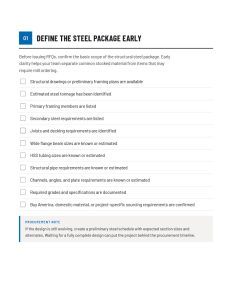 |
Download our Steel Procurement Checklist for Data Center Projects |
Distributor vs. Mill Direct: Which Source Is Right for Your Project?
Mill-direct procurement and distributor sourcing both have a place in data center steel procurement. The right answer depends on schedule, volume, design certainty, and risk tolerance.
Mill-direct ordering can make sense when the project has large committed volume, locked specifications, and enough schedule runway to absorb 14 to 20 week fabrication and delivery windows. It may also help on highly specific sizes or grades that are not commonly stocked. The tradeoff is flexibility. Once the order is placed, changes can be difficult, slow, or expensive.
Distributor sourcing is often better suited to phased or fast-track projects. A regional distributor can help confirm what is available now, what can be delivered quickly, and what should be ordered from the mill immediately. For common structural sections, distributor inventory can compress lead time from months to days or weeks.
That is the Brown Strauss advantage for mission-critical work. When project teams need steel availability, processing support, and delivery coordination, a distributor with broad structural inventory can help reduce procurement risk before it affects the schedule.
Brown Strauss supports data center and mission-critical projects with structural steel products, processing, and delivery capabilities built around real construction timelines.
Five Questions to Ask Your Steel Supplier Before You Break Ground
Before the project schedule depends on steel arriving on time, ask your supplier these five questions.
- Do you have in-stock inventory of the W-shapes and HSS sizes on my beam and column schedule?
This confirms whether you can avoid mill lead times for common sections. - What is your current delivery lead time for items that are not in stock?
This separates readily available material from items that may require a mill order. - Can you hold inventory against a blanket order as design is finalized?
This can help secure material against a project PO while details continue to develop. - Do you offer processing services such as cut-to-length, drilling, or other preparation?
The more work your supplier can coordinate before delivery, the fewer handoffs your team has to manage. - Which critical-path items are most at risk in the current market?
A good supplier should be able to flag the sizes, products, or quantities most likely to affect your timeline.
Lead time is a solvable problem when it is treated as a procurement priority, not an afterthought. The data center teams that move fastest on steel orders, confirm distributor inventory early, and sequence deliveries around erection needs are better positioned to protect the construction schedule.
References
1 – Terrapin Construction Group’s 2026 construction material lead time update: https://terrapincg.com/news/commercial-construction-material-lead-times-2026
2 – Alder Sales Corporation: https://www.alders.com/understanding-navigating-long-lead-times-in-construction/
3 – JLL Outlook on Data Center Capacity: https://www.jll.com/en-us/insights/market-outlook/data-center-outlook
About the Author

Sam Lightbody
Browse By Category
Recent Posts
-
Secondary Steel in PEMB Systems: Channels, Angles & Tubing Sourcing Guide
While pre-engineered metal building manufacturers typically account for the primary frame and standard secondary...
-
When Your PEMB Manufacturer Can't Deliver: Supplemental Steel Solutions
As a procurement specialist, your project schedule does not care that your PEMB manufacturer...
-
HSS Tubing vs. Structural Angles: PEMB Framing Spec Guide
Choosing between HSS tubing and structural angle for metal building framing is not simply...